The Upper limb: Pectoral girdle+The arm
CLAVICLE
CLAVICLE
is like a CRANE

scapula and the free limb are suspended off this crane
it keeps the limb AWAY from the trunk
so the limb can move freely- increases
the range of motion

FIND:
acromium
lateral ⅓
medial 2/3
sternal end

SCAPULA
Is a Triangle!

A FLAT (ish) triangle

Surfaces:
Posterior & Anterior
Borders:
Superior (at the top)
Axillary (near the armpit)
Vertebral (medial, near the midline, near spine)
Angles:
Superior (top angle)
Inferior (bottom, under angle)
Lateral (side angle)
Projections:
Are for attachments, thus they stick out
What attaches to le scapula?
(well, what doesnt?)
(well, what doesnt?)
Achromion (for clavicle)
Coracoid process and spine (for muscles)


HUMERUS
find:
the upper end
shaft
the lower end

*******Workshop QUESTIONS********
Deduce (from the shape of the articular surfaces) the movements permitted at the:
(i) joints of the clavicle
(ii) shoulder joint
(iii) elbow joint (next week)
Are these joints more likely to be mobile or stabilising?
What stabilises them?
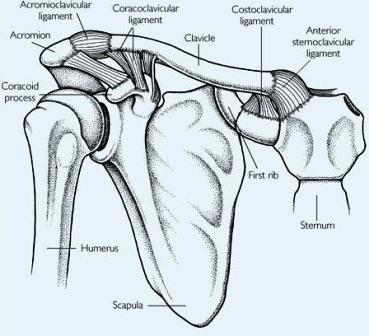
***STERNOCLAVICULAR JOINT***
tightly wrapped sandwich in a box
ARTICULAR DISC sandwiched between CLAVICLE and
the MANUBRUM (of STERNUM)
TIGHTLY wrapped by ligaments at the front and back
(anterior and posterior sternoclavicular ligaments)
in a BOX of joint capsule
attached to the other clavicle through interclavicular ligament
more STABLE or more MOBILE?

as in, the body to the limbs
it needs to be effing solid and stable
but..
IT also allows movements OF THE PECTORAL GIRDLE AND THE upper LIMB
IT also allows movements OF THE PECTORAL GIRDLE AND THE upper LIMB
See figure on Moore, p. 794
MOVES THE LATERAL END OF THE CLAVICLE
There is a DISC in the middle.
What is it for?
Injury: Quite uncommon because it's very strong
ACROMIOCLAVICULAR JOINT
Acromium of scapula-Clavicle
Plane Joint
acromium end(covered by FC)-disc-clavicle end(covered by FC)
WHY fibrocart instead of hyaline?
Movement:
Rotation of the acromial end of the clavicle
Injury: Shoulder separation
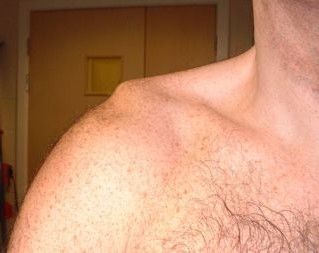
SHOULDER (GLENOHUMERAL JOINT)

BALL AND SOCKET
The most mobile joint in the body
stable?

it would be extremely unstable but,
how about with all these ligaments?

humeral head+glenoid cavity of scapula don't quite fit together :(
but thanks to fibrocart glenoid labrum.
they fit like a dream

articular surfaces covered by hyaline cart as opposed to fibrocart.
WHY?
(mobility)
Three axes
flex-extend
abduct-adduct
rotation (medial-lateral)
circumduction
Indicate bony attachments of major ligaments which help maintain stability
ie. somethings gotto stop these joints from moving everywhere:
predict the bony attachments from the names...
Shoulder:
Glenohumeral ligaments - anteriorly
coracohumeral ligament - superiorly
Acromioclavicular:
coracoclavicular ligament (major stability lig)
coracoachromial ligament (avoids humerus dislocation)
Sternoclavicular:
sternoclavicular ligament (keeps everything together)
costoclavicular lig (costo:rib first rib-clavicle)
Indicate sites where major nerves are directly related to humerus:
Radial nerve- passes through the radial groove of humerus
Brachial Plexus?
